Diagnostics and genomics website design
Diagnostics companies serve ordering clinicians, patients and partners, each with different questions. We design and build websites for diagnostics, genomics and laboratory testing companies that make ordering simple and results understandable, on WordPress, Webflow or Framer.
What the website needs to do
Clinicians need the test menu, ordering instructions, specimen requirements and billing details. Patients need to understand what a test means for them and what happens next. Partners need to know how to work with you. The site should route each group to the right place fast.
Pages most diagnostics companies need
- Test menu: a searchable catalog with test details, specimen types and ordering codes.
- For clinicians: ordering, sample collection, results delivery and support.
- For patients: what each test is for, how results are shared and access to genetic counseling.
- Billing and coverage: how billing works and support for patients and practices.
- Science and quality: your methods and quality practices, stated accurately.
- Partners and careers: lab and research partnerships and open roles.
A test menu built as data
Test menus change often. We build them as structured content with fields for genes, specimen type, ordering codes and status, so search and filters work and every page stays consistent.
Accurate, careful claims
Performance, accreditation and coverage statements must be exact. Your team approves every claim, and we keep the site easy to update when tests or policies change.
Choosing a platform
WordPress suits companies with large test menus, many resources and several editors. Webflow handles structured test catalogs well with a visual editor. Framer fits an early-stage company with a focused menu. Compare the platforms.
How a diagnostics website project runs
- Define: we review your audiences, test menu, ordering process and current site, then agree the pages and who does what.
- Design: we design the clinician, patient and test menu paths with your team.
- Build and review: we build the site and catalog, connect ordering and portal links and test across devices.
- Launch and hand over: we launch, redirect old pages and show your team how to update tests and resources.
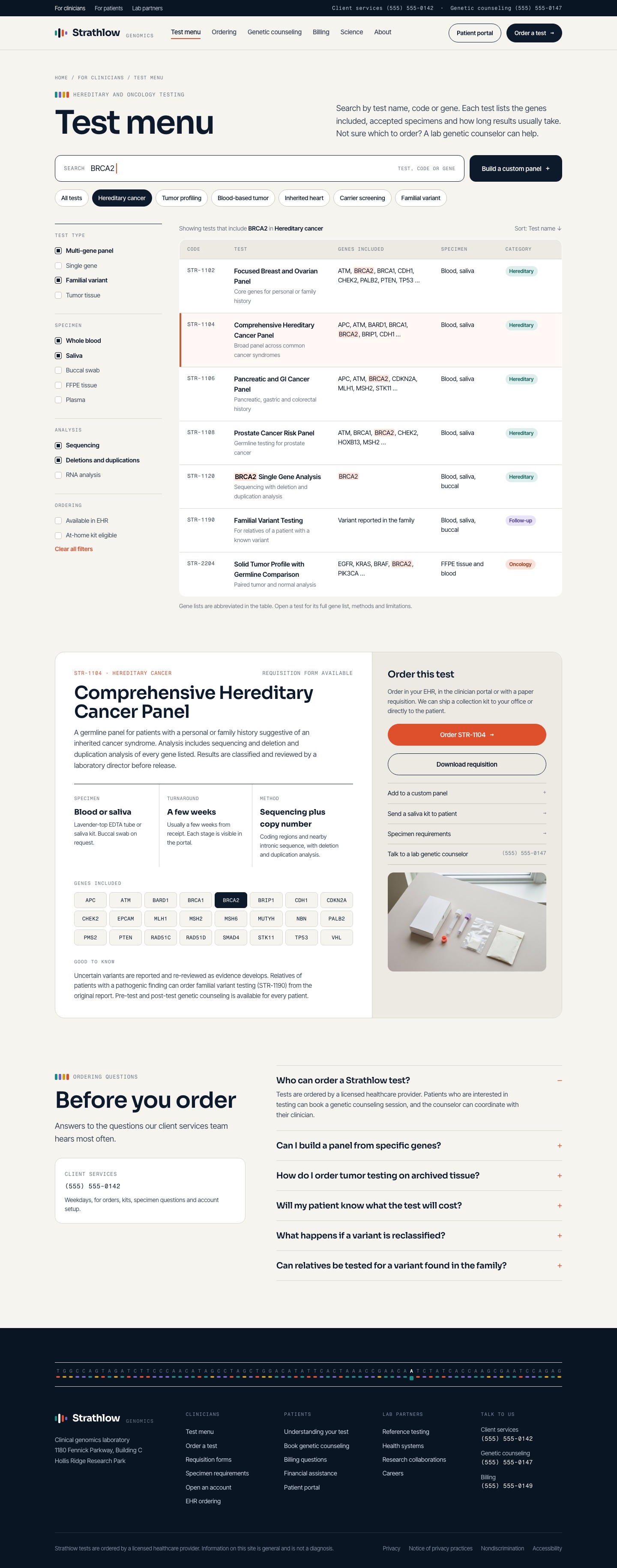
Strathlow Genomics
Diagnostics company website. Select a view to see the full design.


Frequently asked questions
Can clinicians search and filter the test menu?
Yes. Tests are structured records, so clinicians can search by name, gene or category and filter by specimen type or area.
Can patients understand their tests on the site?
Yes. Patient pages explain what a test is for, how results are shared and how to reach genetic counseling, in plain language.
How do you handle performance and accreditation claims?
Your team approves every claim, and we show only what you can support, kept current as things change.
Can the site link to our ordering portal?
Yes. Ordering, results and support links sit wherever clinicians need them.
How much does a diagnostics website cost?
Every proposal is based on the actual scope: test menu size, audiences, integrations, content and any migration. Tell us about your company and we will recommend a scope and send a clear proposal.
Tell us about your project
Share what you are planning, the platform you prefer and any timing. We will review it and follow up with the next step.